
INSPIRING CONFIDENCE. PROMOTING COMFORT.
At Everest Outpatient Surgical Institute, we know that having a joint replacement—whether it’s a hip, knee, or shoulder—can feel overwhelming. That’s why education and preparation are core parts of your care. Our goal is to make sure you feel confident going into surgery and supported throughout your recovery.
ABOUT TOTAL JOINT REPLACEMENT
Total joint replacement is a surgical procedure that removes a damaged joint and replaces it with an artificial implant (prosthetic). We perform:
Total Hips
Total Knees
Total Shoulders
You’ll be cared for by experienced orthopedic surgeons committed to your comfort and recovery.

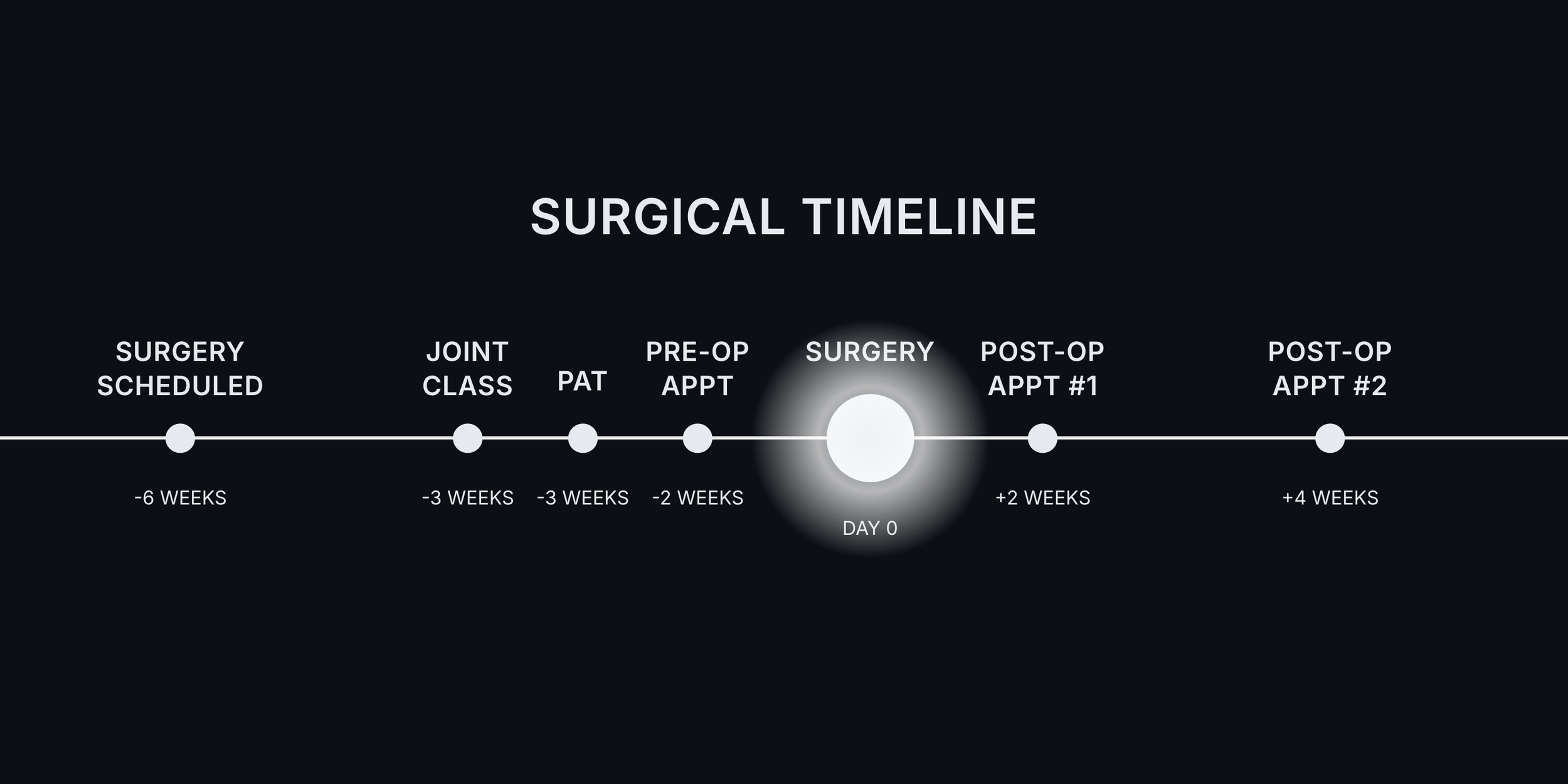
Three weeks before your surgery, you’ll attend a Total Joint Replacement Class, a 2-hour session focused on preparing you for what to expect before, during, and after surgery. In class, we cover:
PREPARING FOR SUCCESS
-
Understanding your procedure
How to prepare your body and home
What to eat and how to get ready physically
How labs, EKGs, and pre-surgical checks work
-
You’ll come into the Everest building 2 weeks before surgery for:
Labs at Express Labs
EKG at Idaho BMI
This information helps your surgeon and our anesthesia providers make sure you’re safe and ready for surgery. We also call you beforehand to review meds, medical history, and anesthesia plans.
BEFORE SURGERY
-
Plan to arrive about 2 hours before surgery. Our front desk will have you review patient’s rights and responsibilities documents and sign consents.
-
In the preoperative area, a nurse will:
Confirm your medical history
Check vital signs
Start your IV
Prepare you for anesthesia
-
We generally use spinal anesthesia for both hips and knees.
An additional adductor canal block is used for knees. We inject Exparel during the block, which provides longer-lasting pain control (up to ~72 hours).
Total shoulders receive an interscalene block using Exparel to numb the nerves in the neck, shoulder and arm for up to 72 hours.
-
You’ll be awake initially, then gently drift to sleep
During the time you are awake, our team will be busy getting you positioned properly on the operating table. It is normal to be awake for this.
You won’t remember anything after anesthesia begins
-
We use state-of-the-art tools to help surgeons place your implant more precisely.
OrthoGrid AI (Total Hips): Helps fine-tune alignment and balance for your joint.
Stryker Mako Robot (Total Knees): Guides precise bone cutting and implant positioning.
DAY OF SURGERY
-
After your procedure, you’ll go to the Post-Anesthesia Care Unit (PACU)
We monitor you until you meet safety criteria (alertness, mobility, breathing, etc.)
Once you’re in phase two of recovery:
Your family may join you
We’ll go over postoperative care and answer questions
-
As soon as your block wears off:
We help you stand, walk, and use the restroom
We make sure you tolerate fluids and food
Once you meet all discharge criteria, you’ll go home the same day.
-
Around 1 week later, a nurse will follow up with a call to see how you’re doing. We are also available to answer any questions you might have.
AFTER SURGERY
Frequently Asked Questions
-
Hips and Knees: You’ll receive spinal anesthesia with an adductor canal block (for knees only) to keep you comfortable. You’ll be put under deep sedation during surgery.
Shoulders: You’ll receive an interscalene block that will provide pain relief in your neck, shoulder, and arm for around 3 days. You’ll also receive general anesthesia during the surgery.
-
Implants vary by surgeon preference and patient needs. Press-fit implants use your bone’s growth to secure the implant, while cemented uses a medical-grade cement for immediate fixation. Our providers generally use press-fit implants.
-
Yes—we discharge patients home once vital signs are within normal limits and symptoms of pain and nausea are controlled. You must safely walk, use the restroom, tolerate fluids and food, and understand home care before we discharge you.
The success of same-day discharge leans heavily on education; therefore, it’s important to attend joint replacement class and read any and all materials provided to you by your surgeon’s office or the surgery center.
-
Recovery varies, but all patients are walking with assistance the day of surgery and continue strengthening over weeks. Your surgeon and therapy team will help provide personalized goals. Therapy will typically begin around 2-3 weeks after surgery.
-
Surgeon-specific questions (meds, follow-ups): Your surgeon’s office
Day-of surgical care & discharge safety: Everest Surgical Institute
-
Our surgeons are committed to using a multi-modal approach to pain relief. We emphasize taking all your medications and icing in an effort to provide pain relief without the need for narcotics.
MOVE FREELY AGAIN.
Every step of your experience is designed to help you recover safely, move confidently, and get back to living fully.